Clyde Hopkins was never an artist who sat neatly inside the usual account of British abstraction.
That is partly because the usual account is too tidy. It likes its movements, its schools, its clean lines of influence. It prefers artists to stand still long enough to be named. Hopkins never quite did that. His work is too agile for it - too funny, too musical, too odd, too formally alert.
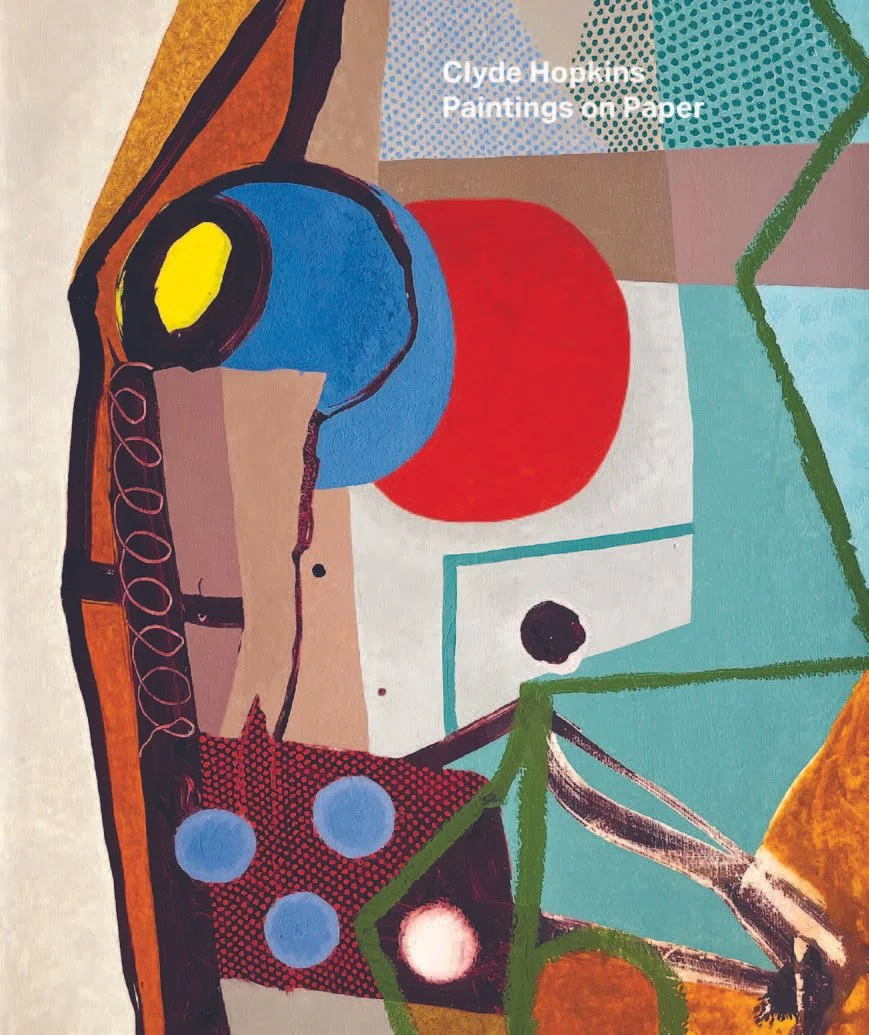
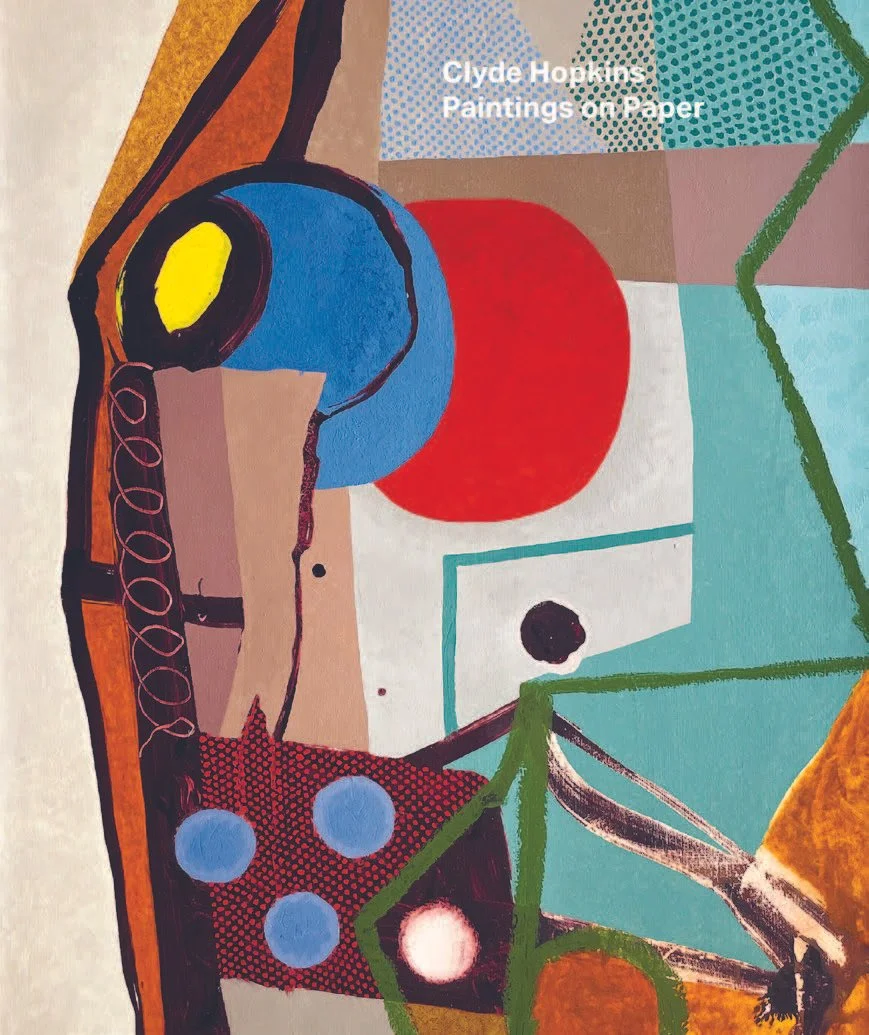
The new book, Clyde Hopkins: Paintings on Paper, focuses on a remarkable body of work made between the early 1980s and the mid 1990s. It is published by Anomie and Blackbird Rook, and edited by Chloe Green and me. It includes a conversation between David Ryan and David Sweet, and essays by Matt Lippiatt and Joan Key.
The book is not a supplement to the paintings. It isn’t a side room, a footnote, or a collection of preparatory studies. These works on paper are where much of Hopkins’ intelligence is at its most immediate. The line is quicker. The colour is more exposed. The rhythm of the picture is easier to hear. And rhythm is important with Clyde.
His paintings often feel as if they are listening to something. Not illustrating music, not borrowing from it in any obvious or decorative way, but thinking musically. There is call and response, interruption, syncopation, accident brought back into order, order made unstable again. A mark starts somewhere and seems to remember something else halfway through. Colour arrives with the force of a brass section, then gives way to a drawing that feels almost like notation.
Peter Doig remembers Hopkins first visiting his studio at Chelsea. Clyde asked him whether he was “the David Byrne of painting” - the kind of painter, he said, who might paint “a giraffe playing a saxophone.”
It is a perfect Clyde remark. Absurd, funny and strangely exact.
It also says something important about the work. Hopkins’ paintings are often off-centre, but never casual. They are playful, but never lightweight. They have humour without flippancy, structure without stiffness and a pictorial intelligence that keeps shifting between improvisation and control.
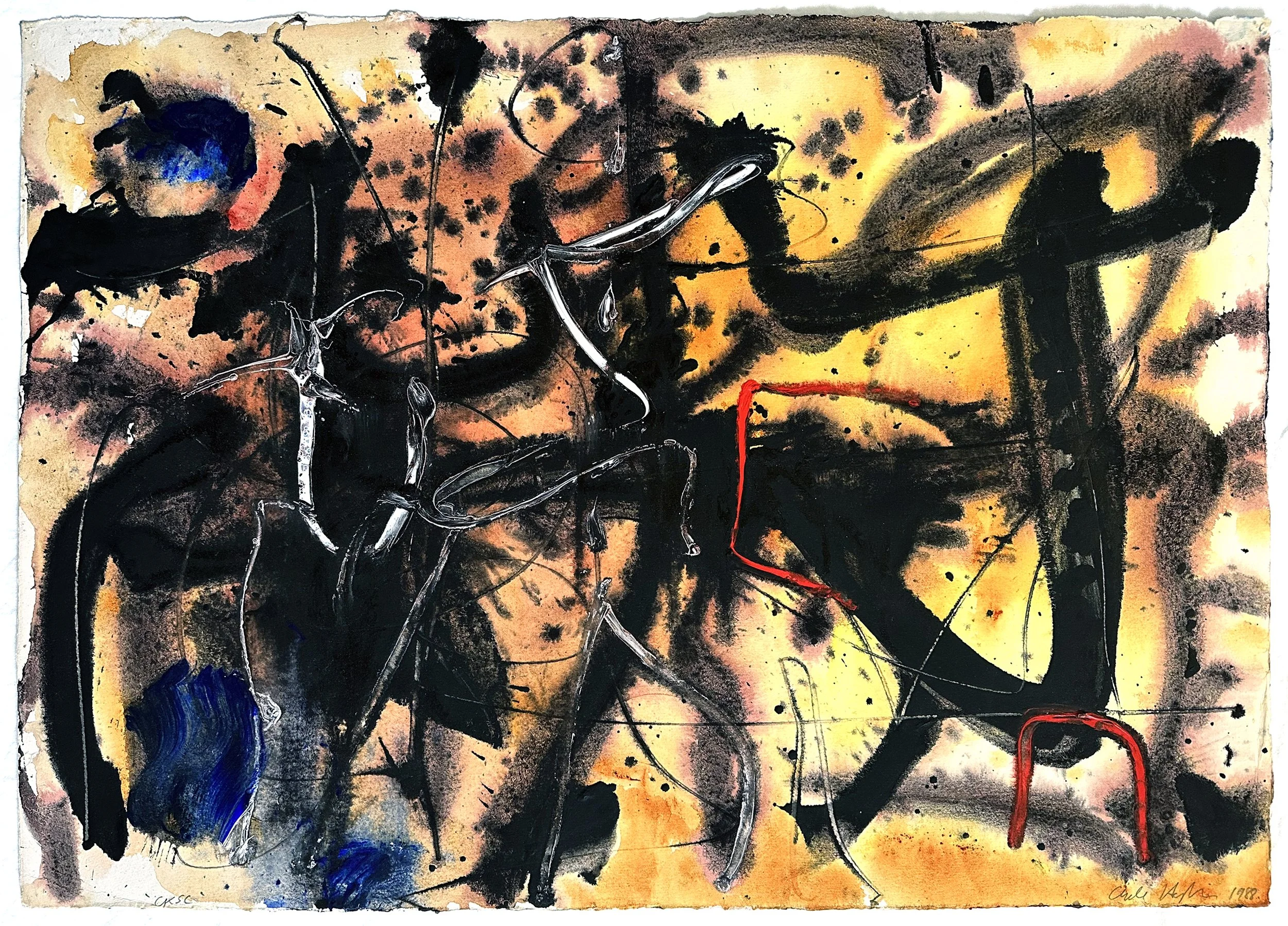
CKSK, 1988, gouache and acrylic on paper, 53.5 × 76 cm
You can see this especially clearly in the works on paper. They don’t feel like smaller versions of the paintings. They feel like places where thought happens at speed. The surfaces are alive with decisions - some abrupt, some lyrical, some comic, some awkward in exactly the right way. There are loops, ladders, grids, sprays, dots, blocks of colour, scaffold-like structures, half-forms, sudden openings. At times they feel close to writing. At others, to maps, diagrams, cartoons, scores, weather systems, bits of street signage half-remembered from somewhere else.
Hopkins once referred to some of his early works as “liquid fields”, and it is a useful phrase. These pictures don’t resolve themselves into fixed images. They move between writing, drawing and painting. They hold together, but they also refuse to settle down. That refusal is one of their pleasures.
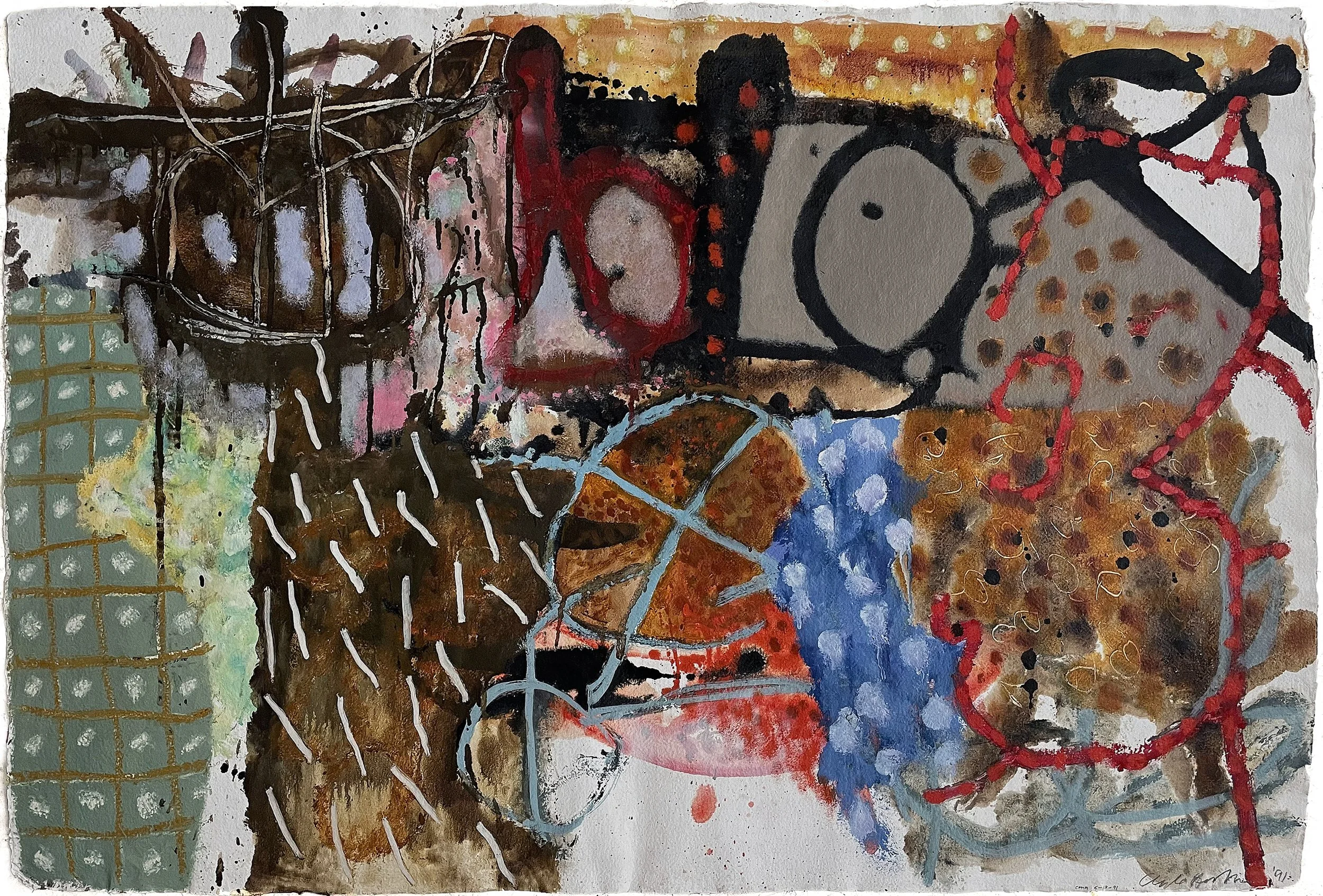
Untitled, 1991, oil on sized Indian rag paper, 71 × 104 cm,
The book covers a period in which Hopkins moved from the charged calligraphic energy of the 1980s towards the more open, chromatic and spatially considered works of the 1990s. The shift isn’t a simple story of wildness giving way to control. It is more interesting than that. The earlier works already have structure, and the later works still have mischief. What changes is the way the paintings breathe. The marks become less like attacks and more like signals. The colour becomes less like an event and more like a place.
Clyde’s position in British painting has always been slightly hard to place, which may be one reason he has not been seen as clearly as he should have been. He was part of things, but not reducible to them. He taught. He argued. He helped build studio communities. He was deeply embedded in the life of painting in London. And yet the work itself has always remained stubbornly his own. That is more important than fashion.
There are painters whose work seems, in retrospect, to have been waiting for the right moment to be seen again. Not because the paintings have changed, but because the surrounding noise has. Hopkins now looks less like a marginal figure in a familiar story and more like an artist who was making his own story all along.
These works on paper are central to that.
They show an artist thinking through painting without pomp, without grandstanding, without the dead hand of seriousness. They are alert, inventive, witty, restless and exact. They have the rare quality of seeming both highly worked and suddenly found.
Paintings on Paper is part of a wider attempt to let Clyde Hopkins be seen properly again - not simply as an overlooked British painter, but as a singular artist with his own pictorial language: eccentric, rigorous, inventive and unmistakably his own.
The book is available now from Blackbird Rook.