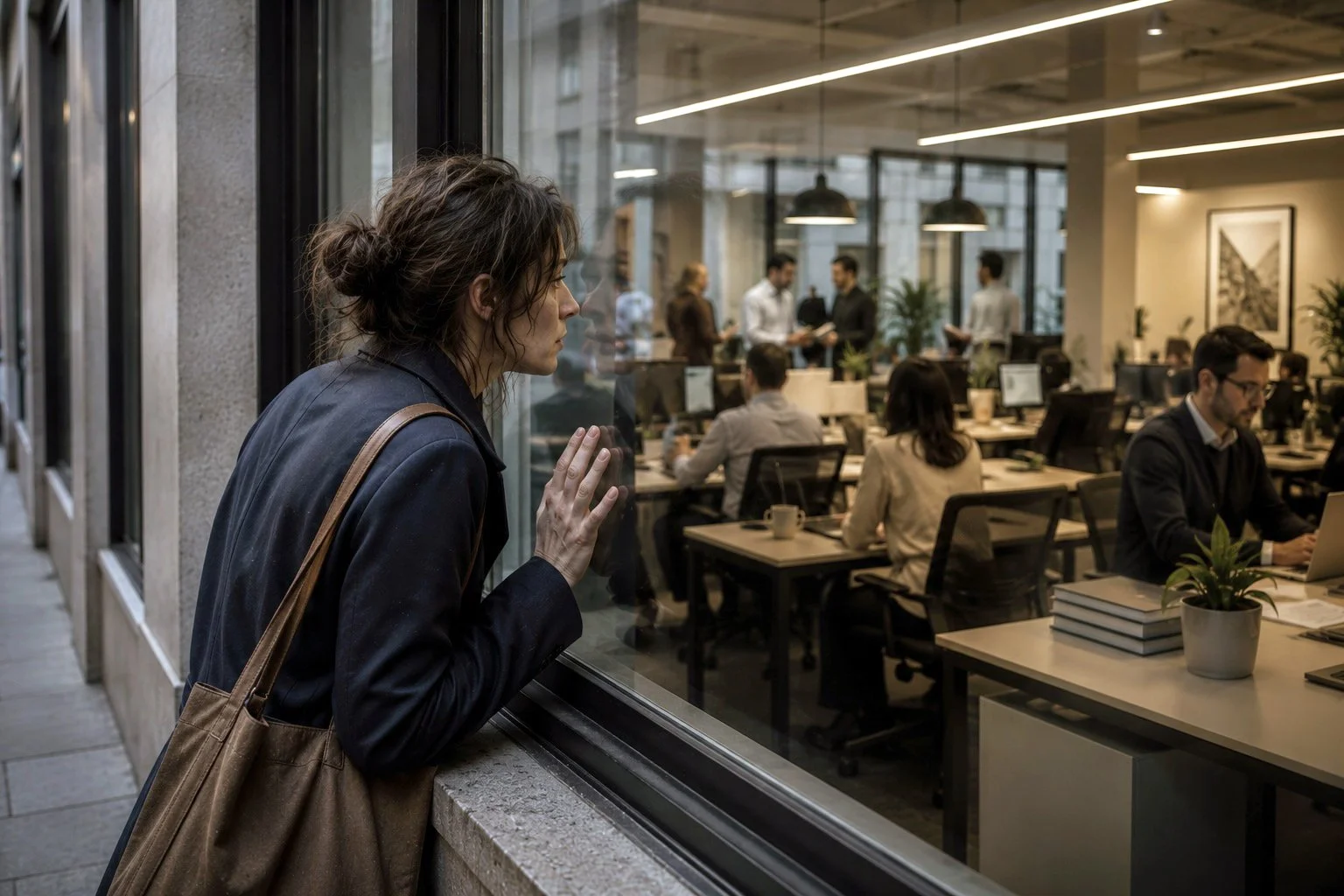
Over the past few weeks I’ve been thinking quite a lot about what it means to start out as an artist.
Partly this came through writing. In Qualified for Nothing, I wrote about that strange, slightly brutal moment when artists leave art school with enormous commitment, highly developed instincts and almost no obvious place to put them. In the piece I wrote for Plaster - which will be published in the next week or so - I looked at another version of the same problem: the awkwardness of having to talk about your own work before the work has had time to do the talking for you.
Both pieces are really about the same thing. Not talent exactly, but seriousness. The long, often unsupported process by which an artist works out what they are actually interested in, how to make that visible and how to keep going once the structure around them disappears.
That has also shaped the June Review I sent those on my collector list, which is slightly different from the usual monthly selection. This month I’ve focused almost entirely on recent graduates, mostly from the Slade and the Royal College of Art. Some of the artists, including Laurie Cole and Yoona Kwon, I’ve introduced before. Others are new to these suggestions.
Buying emerging artists is the higher-risk end of the art market. There is less public record, less price history and much less certainty about what happens next. That is also part of the interest. The work is still close to the conditions that made it. It hasn’t been over-managed, over-explained or fully polished into market language.
Still, risk is not the same as randomness. Artists coming out of places such as the Slade and the RCA have already passed through a serious filter. They have survived a demanding period of scrutiny, argument, doubt and production. That does not guarantee anything, of course. Nothing in art does. But it does suggest a level of commitment and ambition worth paying attention to. My job, as I see it, is to make a further selection from those cohorts: to look for the artists whose work already has a visual intelligence of its own, not just a competent art-school fluency.
At the other end of my work is the responsibility of looking after artists with long, substantial histories.
The first Clyde Hopkins publication, Paintings on Paper, has been an important part of that. Clyde’s work has been central to Blackbird Rook for some time now. Looking after an estate is not simply a matter of presenting inventory. It means trying to bring an artist back into view properly, without flattening the work into a tidy career summary. Clyde’s paintings have too much humour, difficulty, rhythm and sheer painterly intelligence for that.
I’ve also continued working with Marilyn Hallam, whose paintings remain, for me, some of the most extraordinary and under-recognised works I’m involved with. They are strange, intimate and utterly their own. There is a sort of sideways brilliance to them - seemingly tranditional yet so intelligently painted - which still feels far less known than it should be.
Alongside that, I’ve been keeping close contact with artists I’ve worked with for some time, including Zoe Spowage, whose work continues to build real momentum. She is currently included at the RWA as part of a group show in the south west, which feels right for paintings that have always had such a strong sense of weather, body, landscape and pressure. Her best work has that useful quality of being immediately open and then refusing to become simple.
There is another side to Blackbird Rook too, which is almost absurdly different in scale and atmosphere. I’ve also been working with The Art Investment Group on more substantial secondary-market deals, from contemporary works through to Old Masters. It is a very different art world: slower, more discreet, more dependent on provenance, condition, price history, negotiation and trust. In one sense it has little to do with recent graduates from the Slade. In another, it is the same question again: how do you decide what is worth looking at, what is worth owning and what is being misread by the market around it?
That is increasingly what Blackbird Rook is for. Not just access, although access matters. Not just enthusiasm, although enthusiasm helps. The more useful thing is filtration: looking carefully, thinking about where an artist is in their life and work, and trying to match collectors with pieces that have more than surface appeal.
So this is where my attention has been lately: artists leaving art school, an estate that deserves proper care, a living painter whose work still feels under-seen, artists building momentum and a very different secondary market where the numbers get larger but the basic questions remain oddly similar.
What is serious? What is overlooked? What is worth living with?
As ever, I’m always interested to hear what catches your eye, and just as interested to hear what doesn’t.
All the best
Greg