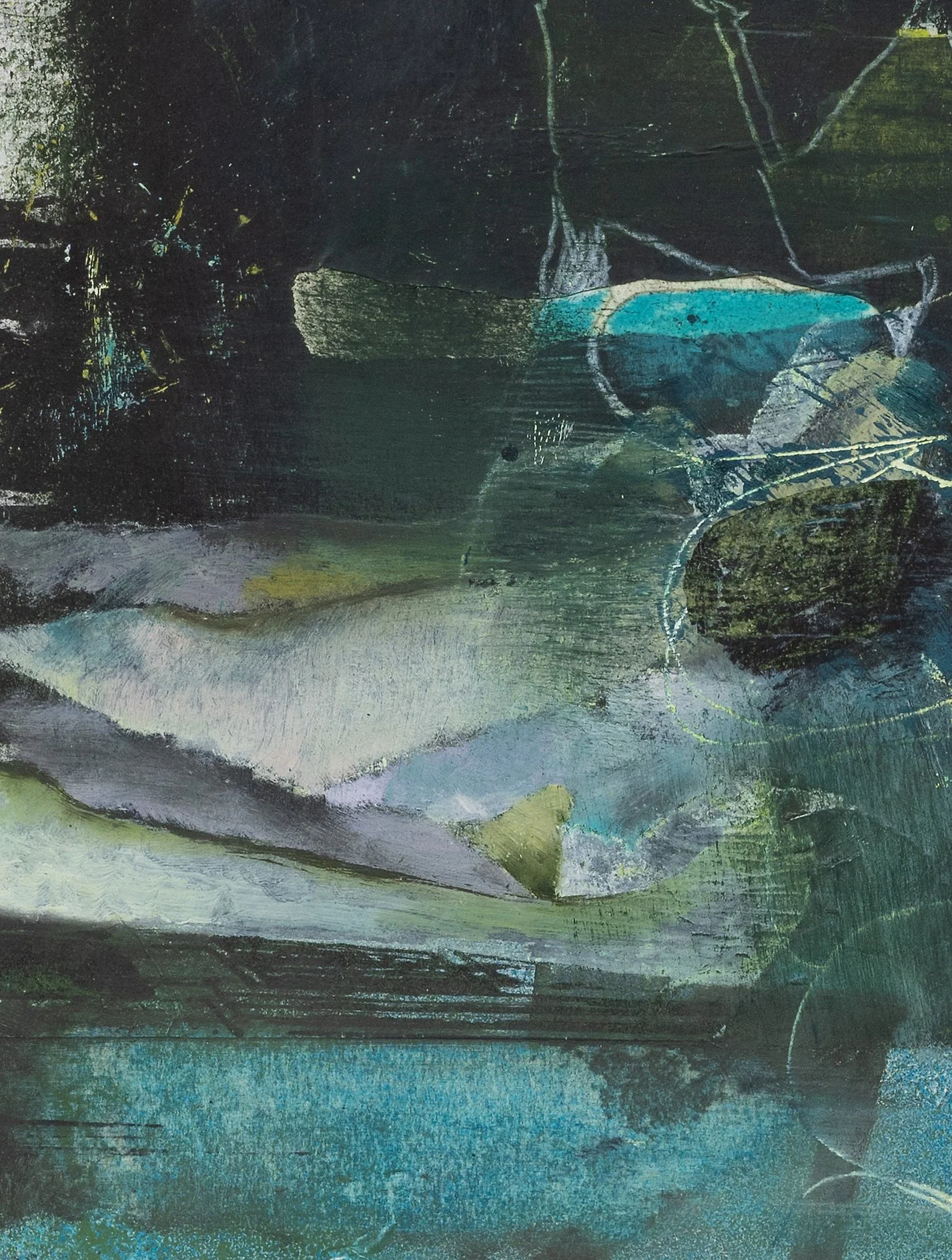
Justin MOrtimer - Works on Paper

Untitled, 2025, Oil, pastel and pasted paper on two sheets, 42 x 59.3 cm
Justin Mortimer occupies an unusual place in British painting. He first came to attention very young, winning the BP Portrait Award in 1991 while still closely associated with the Slade, then followed that with the NatWest Art Prize and the Hunting Art Prize. That early success could easily have fixed him as a society portraitist, but instead he moved away from likeness as status and towards something far stranger - painting as a way of staging psychic disturbance, bodily vulnerability and the dread that ordinary life can suddenly break apart. He still lives and works in London, and his paintings remain grounded in figuration while refusing anything neat, literary or merely illustrative.
What makes Mortimer particularly interesting is that his work is not simply dark, but structurally unsettled. Figures appear half-erased, displaced, masked or broken up by screens, veils, architecture and glitches. In interviews he has linked this to a long-running fascination with aftermaths, uprooted people and the sense that the anticipated world can be corrupted without warning. He has spoken of the Bosnian war as an early trigger, and of preferring implication to direct reportage - aftermath rather than headline. That helps explain why even his most ambiguous works carry genuine emotional pressure. They do not perform crisis. They absorb it.

Untitled, 2024, Oil, acrylic, ink and pasted paper on three sheets mounted on paper, 42 x 68.8 cm

Untitled, 2025, Oil and pastel on two sheets, 33.3 x 56 cm
The works on paper assembled here show Mortimer thinking in a more provisional, porous register. The large paintings often arrive with cinematic scale and dread, but these sheets feel closer to the engine room of the practice: lighter, riskier, more fragmentary. Across them, bodies surface and dissolve, often spread across two or three sheets, with empty ground doing as much work as description. Pastel, charcoal, crayon, watercolour, acrylic, enamel, ink and pasted paper all interrupt the authority of oil, so the image feels found, revised and half-remembered rather than declared. That matters because Mortimer's process is built on collage - initially physical, later digital - using found imagery, books, scans and Photoshop as catalysts rather than ends in themselves. In these works on paper, that archaeology is not hidden. It is the subject.
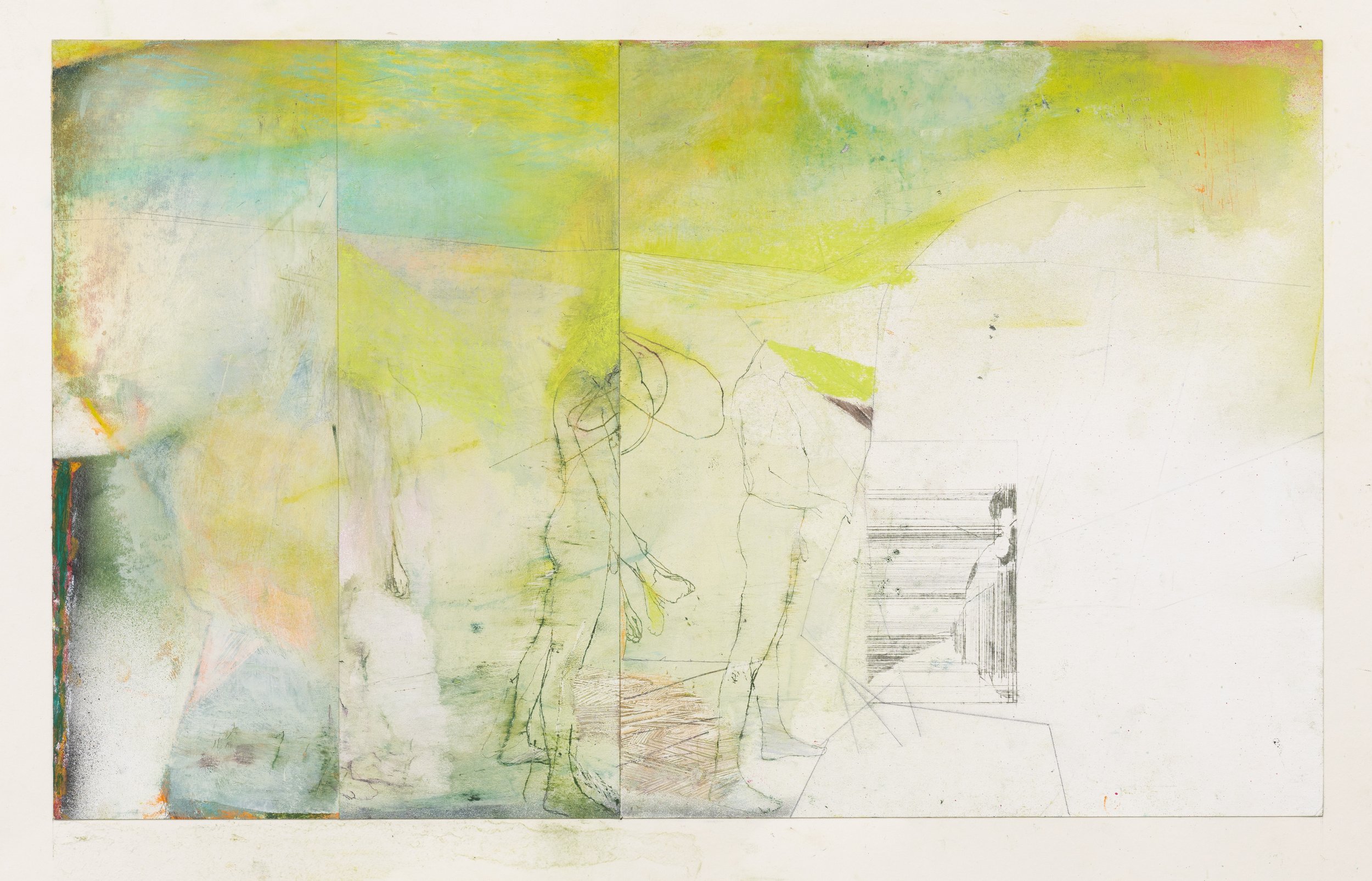
Untitled, 2024, Oil and pastel on three sheets mounted on paper, 42 x 68.7 cm
They also broaden the sense of what his art is doing. The recent OHSH Projects exhibition VEIL brought together Pelt, Kammer and the Zone works under themes of concealment, absence and post-event remains. That is useful here. In these works on paper, clothes, limbs, gestures and erased grounds all read as residues - traces of persons rather than stable figures. At moments they even recall the flower paintings of Breed, Hoax and Taxa, where Mortimer allowed play, colour and abstraction to come forward, only for mortality to remain in the room. These works on paper do not feel secondary to the paintings. They feel like the place where Mortimer's language becomes most exposed: less resolved, perhaps, but also less defended, and in some ways more haunting.

Untitled, 2023, Oil, acrylic, enamel, ink and pastel mounted on paper, 46.8 x 29.7 cm