Who Gets Space? John Hoyland, Clyde Hopkins and the history we make room for.
The following was written for the Blackbird Rook Substack.
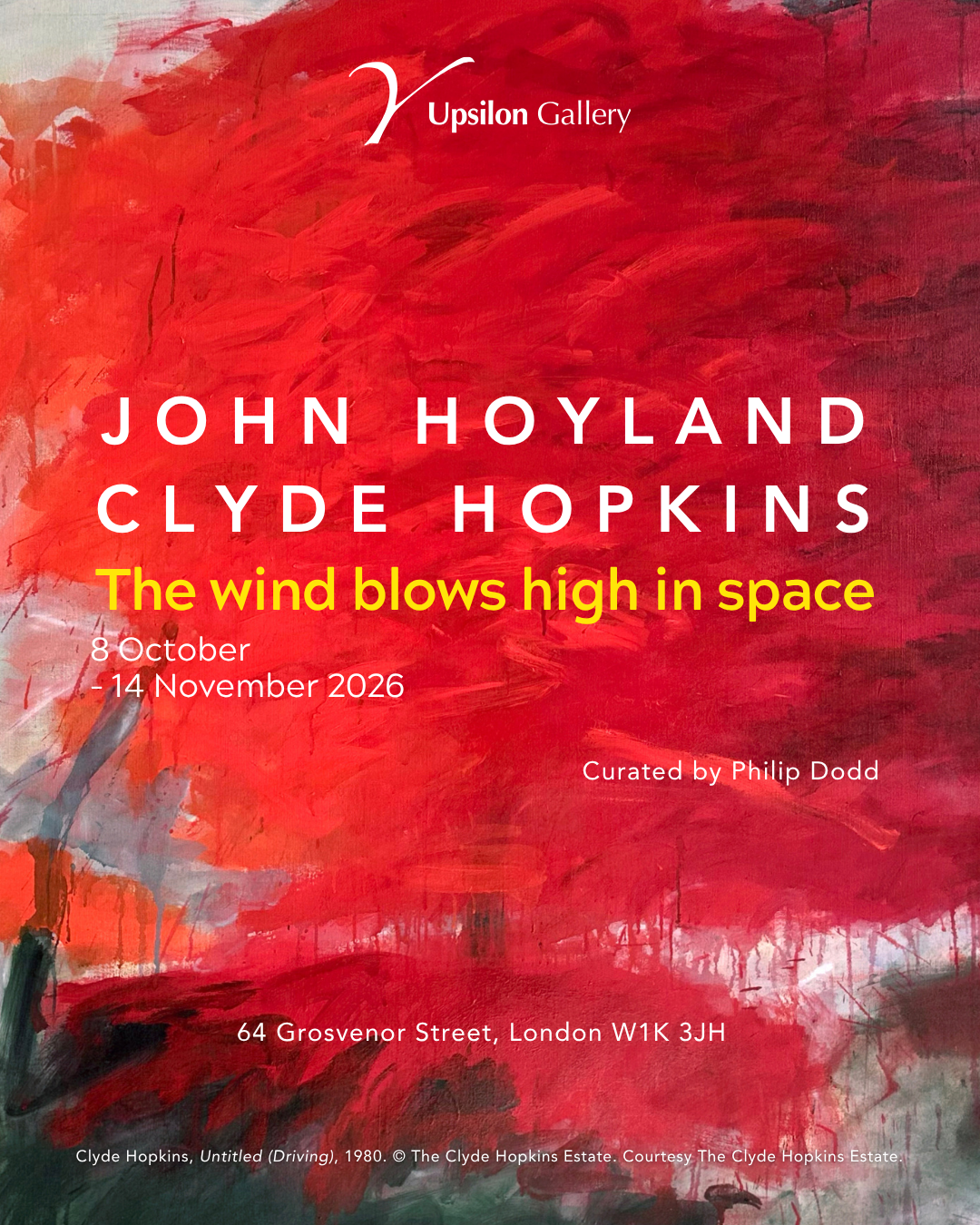
There are several kinds of space in painting… there is the space inside the picture, there is the world apparently beyond it, there is the strange depth a painter can create on something which is completely flat, and then there is another kind of space altogether… whether anyone continues to make space for the artist once the paintings have left the studio. I have been thinking about this because, opening on the 8th October at Upsilon in London, is bringing together John Hoyland and Clyde Hopkins in an exhibition curated by Philip Dodd. Dodd’s starting point is space, in its various meanings. Sky and outer space are part of it, but so is pictorial space - the problem painters have been worrying away at for centuries: how a painting constructs somewhere for things to happen when there isn’t really anywhere there at all.
In our conversations about the exhibition, Dodd has talked about the curious preoccupation many abstract painters have had with the sky and what lies beyond it. Not necessarily because they wanted to paint the heavens, but because thinking about that apparently limitless space became a way of thinking about painting itself. John Hoyland was one of them, and so, in a different way, was Clyde Hopkins. Hopkins once described looking through a window in south-east London at an evening star, an illuminated cloud and a fading vapour trail. Their positions changed as the earth turned and the wind moved above him. He wrote:
…looking up at the twilight sky of early spring in South East London, the window frames three elements - the evening star, a cloud illuminated by the setting sun, a fading vapour trail. The relative position of these three elements, light or dark against the luminous cold blue space of the sky, changes slowly. The world turns gracefully, inexorably; the wind blows high in space.[1]
It is a beautiful description of looking upwards. It is also, I think, quite a good description of his paintings. Things float, collide, become obscured, come forward and disappear again. A line can suddenly become an object. A patch of colour can be atmosphere or matter. The paintings do not so much depict space as continually renegotiate it.
Hoyland does something related, although the paintings look very different. Even in his most apparently non-referential work he never entirely abandoned the possibility of illusionistic space. His rectangles, stains, pours and splashes operate as what Hales gallery describes as a kind of “spatial drama”, forms suspended, blocked, advanced or pushed backwards within the painting. Putting Hoyland and Hopkins together therefore makes more sense than simply gathering two British abstract painters from neighbouring generations.
And there is also an historical connection. Hoyland was born in 1934, Hopkins in 1946, and in 1980, when Hoyland was invited to select the Hayward Annual, he chose two paintings by Hopkins. The exhibition has become an interesting historical document because Hoyland was making an argument for painting at just the moment when its status appeared increasingly uncertain. Among the artists he selected were Frank Bowling, Clyde Hopkins, Mali Morris, Geoff Rigden and Jeff Dellow. It wasn’t a movement - nobody appears to have devised a catchy name for it… it was closer to an ecology: painters working alongside, arguing with, teaching, exhibiting and looking at one another.
The Hopkins selection is particularly interesting now. Peter Fuller, reviewing the Hayward Annual, thought Hopkins a painter of considerable promise and recognised in one of the paintings something approaching the sublime. Forty-six years later, the interesting fact is not whether Fuller got everything right, it’s that Hopkins was inside the serious argument about British painting. Six years later, something even more telling happened. In March 1986 the Serpentine mounted concurrent exhibitions by Frank Bowling, John Gibbons and Clyde Hopkins. Three artists, each being taken seriously enough to occupy the Serpentine, at the same time.
We know more about what happened to one of them. Frank Bowling has subsequently received the sort of full historical reassessment that changes the public understanding of an artist. Tate Britain staged a major retrospective in 2019, accompanied by the first publication to survey the whole of his sixty-year career. Even the Royal Academy now describes the attention Bowling has received over the past decade as “belated”. And Hoyland’s position has also been repeatedly restated.
He had already received an early retrospective at the Whitechapel in 1967, a major Serpentine exhibition in 1979, a Royal Academy exhibition in 1999 and a Tate St Ives retrospective in 2006. After his death, Damien Hirst chose more than thirty Hoylands from his own collection to inaugurate Newport Street Gallery in 2015. Power Stations was a serious survey of paintings from 1964 to 1982 and Hirst made no secret of the importance Hoyland had had for him as a young artist.
Since then there has been the work of Hoyland’s widow, Beverley Heath-Hoyland, the Estate, the writer and curator Sam Cornish and, since 2021, Hales Gallery. Cornish is now co-editor of the catalogue raisonné, and exhibitions in London, New York, Sheffield, Latvia and elsewhere have continued to put different parts of Hoyland’s career back into circulation.
Hoyland was never exactly forgotten. What happened was more interesting than that. He was remembered repeatedly. That may be one of the largely invisible mechanisms by which an artist becomes historically secure. A career is not established once and then safely deposited in a vault. It has to be restated. Paintings have to come back out of storage. Somebody has to write another book. A curator has to look again. A younger artist has to say, actually, this is great. Museums have to acquire the work. The same artist has to be encountered by successive generations under slightly different conditions. Some careers receive that process of repetition. Others don’t.
And this is where Hopkins becomes interesting. He didn’t lack institutional recognition during his lifetime. There were Serpentine exhibitions in 1978 and 1986, Acme, Ikon and Rochdale, the Hayward Annual, the Whitechapel, Modern Art Oxford and numerous other exhibitions. He became Head of Painting at Winchester and later Professor of Painting at Chelsea. He was deeply embedded in British painting rather than standing outside, hoping somebody might notice him. But the mechanism of repetition became less reliable. Perhaps that is part of the untold story of British painting in the 1980s. There is a whole constellation around Hopkins, Bowling, Mali Morris, Geoff Rigden, Jeff Dellow and others whose individual fortunes subsequently diverged enormously. Albert Irvin, Basil Beattie and John McLean sit nearby in the larger story. It would be misleading to turn them into a movement after the event, because they weren’t one. What connects them is something looser and perhaps more interesting: a conviction that painting remained capable of carrying serious experience at a moment when the art world’s attention was increasingly moving elsewhere. The 1990s then supplied British art with a really vivid alternative story. It had Goldsmiths, Freeze, Sensation, sharks, beds, YBAs and an exportable collection of stories. Painting didn’t disappear, but it became harder for certain kinds of painting to occupy the centre of the story.
There is also an institutional question here. The Whitechapel that gave the thirty-two-year-old Hoyland a retrospective in 1967 and the Serpentine that mounted substantial exhibitions by Hoyland, Hopkins, Bowling and their contemporaries belonged to a particular cultural ecology. Today’s institutions have different remits, audiences and increasingly international horizons. That change has brought enormous benefits, but one consequence is that the mechanism by which a significant British painter might periodically receive a substantial public survey is less straightforward than it once was.
This is not an argument for turning the clock back, or for museums to spend their lives tidying up every loose end in British art history, but it does mean that other people increasingly do some of that work. In Hopkins’s case, something interesting has been happening. Tate acquired Kent to Yorkshire (via the DT), 1983–84, in 2020. The Hepworth Wakefield acquired Seagulls, Brian Sewell, Kicking etc., 1992, in 2023. There was a museum exhibition at The Dock Museum in Barrow in 2022 and a substantial show of late 1980s paintings at Upsilon in New York the same year. Castor presented the 1989–93 paintings in London in 2023, followed by Blond Contemporary presenting late works and Alice Black’s exhibition of the early 1980s paintings in 2025.
This year Blackbird Rook and Anomie published Clyde Hopkins: Paintings on Paper, bringing together work from the early 1980s to the mid-1990s with writing by David Sweet, David Ryan, Joan Key and Matt Lippiatt. Key’s essay is particularly relevant to Dodd’s exhibition because it considers Hopkins’s abstraction through experience, and the way immediate perception becomes structure, space and time within a painting. None of these things individually constitutes the great retrospective, but collectively, they look like something.
And perhaps this is where the pairing with Hoyland becomes more than an attractive exhibition idea. Hoyland is not simply a stylistic predecessor to Hopkins. That would be too neat. He is something more useful: a witness. He saw Hopkins’s work early. He chose it for the Hayward. He placed it inside his argument about what painting might still be capable of doing. Frank Bowling was there too. The Upsilon exhibition therefore reconnects two artists who were already connected before most of us started constructing histories explaining what British art in the 1980s was supposed to have been about. And Philip Dodd has found an unexpectedly good word through which to do it. Space. The space inside the painting. The space behind a colour. The distance between an evening star and a vapour trail. The space above London. The peculiar space created when a flat canvas persuades us that something can move backwards into it. And then, finally, the space we make for an artist.
Art history is not just a question of who was good enough to survive, but also a question of who was given enough room to remain visible. Clyde Hopkins was there. Hoyland saw him. Bowling was beside him. The paintings never went away, we just stopped giving some of them enough space.
Blackbird Rook represents the Clyde Hopkins Estate.
Click here to read Blackbird Rook’s Substack.
[1] Clyde Hopkins, introduction to ‘Touch’, an exhibition of paintings curated by Mali Morris, Chelsea Future Space, April 17th – June 17th, CHELSEA space, 2007, np.